Baby Phone & Kids Games
- 4.3
- Rating
- 5.00M
- Installs
- Free
- Price
 Analysis by App-foxy
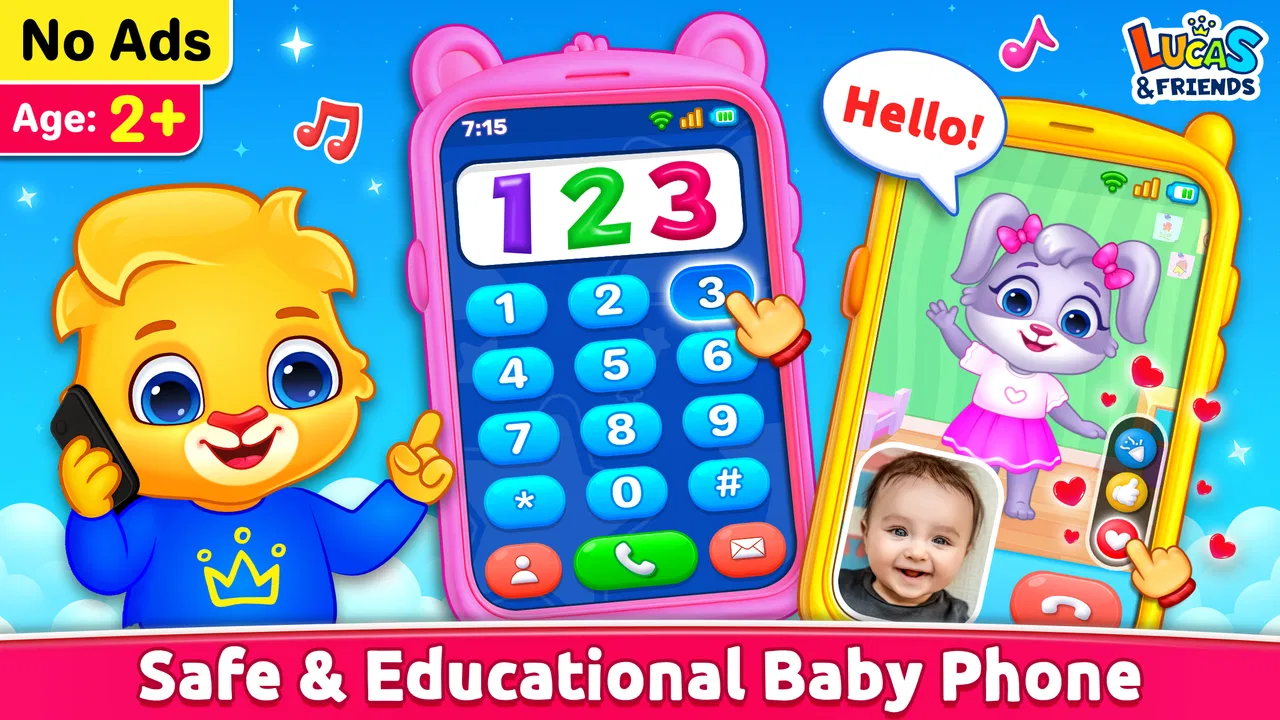
What stayed with me after trying Baby Phone & Kids Games is how deliberately it turns a familiar object—the phone—into a simple learning prompt. Instead of treating a screen as a place for long lessons, it uses the idea of calling, tapping and hearing responses to make early practice feel like play. That focus gives this educational game a clear purpose, especially for toddlers who are more willing to explore a pretend phone than sit through a formal alphabet or counting exercise.
I see it as a short-session activity for young children, not a complete early-learning program. The experience brings together sounds, numbers, ABC practice and pretend phone calls, so a child can move between recognition and playful interaction without needing to read instructions. In my experience, that makes it easier to introduce during a quiet moment, while waiting somewhere, or when a parent wants a small activity rather than another long video.
The game is free and aimed at everyone, which makes it approachable for families looking for a low-commitment download. RV AppStudios is the developer behind it, and the game sits in the educational category. It has reached over a million installs and holds an average rating of 4.1 from around 2.7 thousand ratings, with 19 written reviews. Those figures suggest that it has found a real audience, although I would still judge it by how well its style matches a particular child rather than by popularity alone.
You May Also Like

 Blood Strike: 2.5 Anniversary
Blood Strike’s Loadouts Turn Every Drop Into a Tactical Gamble
A close look at Blood Strike’s custom loadouts: how fast access to signature weapons reshapes its battle royale rhythm, rewards preparation, and narrows the gap between fights.

 Pandora - Music & Podcasts
Pandora’s Music Is Easy to Start, but Harder to Recover
Pandora’s strength is its low-effort path from a seed to a station. Its weak spot is how much confidence it asks you to place in connection, setup, and quiet recovery.

 8 Ball Pool
 Is Built on Rivalries, Rematches, and Routine
A close look at the rivalries, rematches, shared routines, and unanswered safety questions that turn a quick pool match into a persistent mobile community.

 Samsung Music
’s Quiet Strength Is Playing What You Already Own
Its reach comes less from spectacle than from dependable access to a personal library. That simplicity is both the app’s strongest retention engine and its ceiling.

 AccuWeather: Weather Radar
AccuWeather Review: A Quick, Clear Forecast for Everyday Decisions
For everyday plans, the best forecast is the one you can understand quickly. AccuWeather makes rain timing, radar, and local conditions easy to act on, with a few trade-offs.

 Hill Climb Racing
Why Hill Climb Racing Still Turns Crashes Into One More Run
A tiny car, a bumpy hill and one more upgrade: Hill Climb Racing keeps resurfacing because its simple chaos makes every near-miss feel personal.
More From Our News Desk



Why the pretend-phone idea matters
The most important capability here is not simply that children can hear letters or numbers. It is the way those learning elements are placed inside a pretend phone experience. That framing gives each tap a recognizable purpose. A child can feel as if they are making a call, listening for a response, or exploring a toy, while the adult can use the same moment to name what appears on screen.
This matters because toddlers often learn through repetition without wanting repetition to look like a lesson. A conventional alphabet app may present a fixed sequence of letters, while a basic counting game may ask for a direct answer. Baby Phone & Kids Games offers a softer entry point: the child explores first, and the parent can turn the resulting sound or symbol into a quick conversation.
I found the approach most useful when the adult treats the game as a shared prompt rather than handing over the device and walking away. If the screen presents a number, I can say it aloud, ask the child to find the same number again, and then connect it to something nearby. If a letter appears, I can follow it with a familiar word. The app supplies the spark; the learning value grows through the response around it.
That distinction also explains where the game is strongest. It is well suited to first exposure, recognition and confidence-building. It is less suitable when a child needs a structured path through phonics, handwriting, spelling or mathematics. The pretend-call format makes practice inviting, but it does not replace the broader range of activities found in a dedicated reading or preschool curriculum app.
Turning taps into a small learning routine
I would use the game in very short rounds. A useful routine is to choose one theme, let the child explore it, and then stop while the activity still feels fresh. For example, an adult might spend one round on numbers, asking the child to repeat each sound, and save letters for another moment. Mixing everything immediately can be entertaining, but focusing on one idea makes it easier to notice what the child actually understands.
Another practical technique is to make the phone a conversation starter rather than a reward. Instead of saying, “You can play after you finish,” I would say, “Let’s call and find the letter we heard.” That small change keeps the activity connected to attention and language. It also reduces the chance that the child sees the app only as a source of random tapping.
For children who are still developing speech, the audio-led design can be helpful because it gives them something concrete to imitate. I would not pressure a child to repeat every sound, though. Some toddlers will listen several times before speaking, and that quiet recognition is still a reasonable early step. The best use is relaxed and responsive, with the adult adjusting the pace to the child.
What a normal session feels like
Imagine a parent preparing dinner while a toddler sits nearby with supervision. The child wants to handle a phone, but the parent does not want to hand over a personal device or open a complicated game. This app can fill that narrow gap: the child explores a familiar pretend-phone setting, hears sounds and encounters early learning material, while the parent checks in between tasks.
In that situation, I would set a clear boundary before starting. The child can explore for a few minutes, then the phone is put away for a different activity. That matters because the app’s appeal comes from immediate interaction, and a toddler may naturally want to continue tapping. The game works best as one tool in a rotation that also includes books, conversation, physical toys and hands-on counting.
A second good scenario is travel or waiting time. When a child is tired or restless, a compact activity can be easier to manage than carrying several learning toys. The parent can ask the child to identify a sound, repeat a number, or connect a letter to a sign or object in the surroundings. This gives the digital session a useful endpoint: what happens on the screen can lead back to the real world.
I would be more cautious about using it during meals, immediately before sleep, or as a way to settle every upset. Even an educational game is still screen entertainment, and its learning value falls when it becomes background noise. The pretend-phone concept is most effective when the child is alert enough to notice the sounds and the adult is available to add meaning.
Where it fits beside other children’s apps
Compared with a digital storybook, this game is more interactive but usually less rich in narrative and vocabulary. Compared with a dedicated alphabet app, it feels more playful and less like a lesson, but it may not offer the same depth for letter progression. Compared with a simple music or nursery-rhyme app, it puts more emphasis on recognition of numbers and letters rather than passive listening.
That makes the choice fairly straightforward. I would pick this game for a child who is attracted to phones, enjoys sound-based play, and needs an approachable introduction to early symbols. I would choose a more structured alternative for a child who is already ready for tracing, phonics sequences, word building or guided counting challenges. There is no contradiction in using both styles, but they serve different moments.
The game’s advantage is its low barrier to entry. A toddler does not need to understand a complicated menu before the central idea makes sense. Its limitation is the same simplicity: parents looking for detailed progress tracking, a carefully staged curriculum or deeper practice may find the experience too light. I would not install it expecting a full teaching system.
Small choices that improve the experience
One useful habit is to let the child lead the first exploration, then repeat the same area with a goal. The first pass reveals what attracts attention. The second can be more intentional: find a particular number, listen for a familiar sound, or name the letter that appears. This two-step approach prevents the adult from turning the first contact into an interrogation while still creating a learning opportunity.
I also recommend using real objects to extend counting. If the game presents a number, place a few blocks, spoons or toy animals nearby and count them together. The screen then becomes a starting point for one-to-one counting rather than an isolated visual exercise. This is especially valuable because toddlers can recognize a symbol without yet understanding its quantity.
For letters, connect only to words the child already knows. Asking for several examples at once can make a short game feel like a test. A single familiar object—a ball, cup or toy—provides a better bridge. I found that this keeps the tone playful and helps the child understand that the letter sound belongs to language outside the app.
Another trade-off is sound. Audio is central to the experience, so a noisy room can reduce its usefulness. In a busy environment, I would keep the session brief or move somewhere quieter. If the child cannot hear clearly, tapping through the activity may continue, but the main educational connection becomes weaker. This is a practical limitation that is easy to overlook when judging the app only from its concept.
What parents should expect from the current release
The current release is version 1.1.3 and works on devices running Android 6.0 or later. That makes it relevant for families using an older compatible Android phone or tablet rather than requiring a recent device. I would still check the device’s own store page before installing, particularly if the child will use a shared family device, because the experience of any children’s game depends heavily on the screen, speaker and general condition of that hardware.
Because the game is free, it is easy to try without making a financial commitment. That is useful when a parent is unsure whether a toddler will respond to the pretend-phone format. Free access also makes it practical to keep as a backup activity. Still, “free” should not be confused with “a replacement for offline play.” I would evaluate it by whether it earns a small place in the child’s routine, not by how long it can hold attention.
The everyone age rating is consistent with its broad family positioning. In practice, I would still supervise a young child. Age labels describe suitability at a general level, while individual children differ in attention span, sensitivity to sound and ability to stop using a device. A parent’s presence is particularly helpful here because the app’s strongest benefit comes from turning taps and sounds into conversation.
The store summary highlights phone calls, sounds, numbers and ABC learning, but I would interpret those elements as an invitation to interact, not a promise of mastery. A child may enjoy repeating a sound without remembering it later. That is normal for early learning. To judge progress fairly, watch what the child can recognize away from the screen on another day, rather than counting how many times the app was opened.
Who benefits most, and who should pass
I think the best match is a toddler or preschool-age child who is curious about phones and responds well to audio cues. It can also suit a parent who wants a simple shared activity that introduces letters and numbers without the pressure of a formal lesson. Families with an older Android device may appreciate the modest minimum system requirement, while families seeking a free option can test the format easily.
I would skip it if the main goal is handwriting practice, detailed phonics instruction, advanced counting or measurable lesson progression. It is also not my first choice for a child who becomes frustrated by sound-based repetition or who needs slower, tactile activities. A physical alphabet puzzle, picture book or counting set may be more effective in those cases because the child can manipulate objects directly and receive immediate guidance from an adult.
I would also avoid making it the default answer whenever a child asks for a real phone. The pretend-phone idea is useful precisely because it can redirect that interest into learning, but it should not encourage constant device access. A short session followed by talking, drawing or movement gives the concept its proper place.
My overall view is positive but specific: this is a focused educational game, not an all-purpose preschool teacher. The phone-call framing makes early sounds, numbers and ABC exploration feel approachable, and that can be a genuine advantage for children who resist conventional lessons. The experience becomes much more valuable when a parent adds questions, objects and real-world examples around it.
If I were recommending it to a friend, I would say to try it for its central idea, keep sessions short, and use it alongside books and hands-on play. Its real strength is the bridge between pretend phone play and a shared learning moment. With that expectation, Baby Phone & Kids Games is an easy free option for early exploration, while families needing a structured curriculum should look for a more specialized companion.
FAQs for Baby Phone & Kids Games
01What age group is Baby Phone & Kids Games suitable for?
Baby Phone & Kids Games is designed for children aged 1 to 5 years old. The app offers simple, interactive activities that are perfect for toddlers and preschoolers. The games are crafted to engage young minds and help develop basic skills such as color recognition, counting, and hand-eye coordination.
02Are there any in-app purchases or advertisements in Baby Phone & Kids Games?
Yes, Baby Phone & Kids Games may include in-app purchases and advertisements. The app offers a free version with limited features, and additional content can be unlocked through purchases. Ads are often present in the free version, but a premium version is typically available to provide an ad-free experience.
03Does Baby Phone & Kids Games require an internet connection?
Baby Phone & Kids Games primarily works offline, making it convenient for use during travel or in areas without internet access. However, an internet connection may be required for downloading the app, accessing updates, or making in-app purchases. Always check the app’s specifics for any online features.
04What educational benefits does Baby Phone & Kids Games offer?
The app is designed to support early childhood development by offering games that teach numbers, colors, shapes, and animal sounds. It helps improve cognitive abilities, motor skills, and auditory learning. Parents can use the app as a fun, interactive tool to supplement their child’s early education.
05How can I ensure my child’s safety while using Baby Phone & Kids Games?
To ensure safety, it’s recommended to supervise your child while they play. Enable parental controls on your device to prevent accidental purchases and restrict access to other apps. Baby Phone & Kids Games usually includes child-friendly content, but monitoring ensures a safe and controlled environment.
Pros
- Engaging and colorful interface.
- Educational mini-games included.
- Easy navigation for toddlers.
- No internet required for play.
- Parental control features available.
Cons
- Limited free content options.
- In-app purchases can be pricey.
- Ads in the free version.
- Some games are repetitive.
- Not suitable for older kids.

Baby Phone & Kids Games
Gallery